
If you think you might have a warrant, the uncertainty can be worse than the warrant itself. The good news: you can check for warrants CT residents may have for free, using official Connecticut tools, without walking into a police station. This guide explains the types of warrants in Connecticut, five free ways to check, what online searches will not show you, and exactly what to do if you find one, including how to turn yourself in with a bail bond already lined up.
Table of Contents
What Is an Arrest Warrant in Connecticut?
An arrest warrant is a court order signed by a judge that authorizes police to take a specific person into custody. In Connecticut, warrants usually come from one of two places: police who ask a judge to approve new criminal charges, or the court itself when someone misses a court date, violates probation, or is ordered to serve time.
A warrant does not expire just because time passes. In most cases it stays active until the person is arrested, turns themselves in, or a judge cancels (vacates) it. That is why it is smart to check for warrants in CT if you have any reason to think one exists, such as a missed court date or a probation problem.
Common Types of Warrants in Connecticut
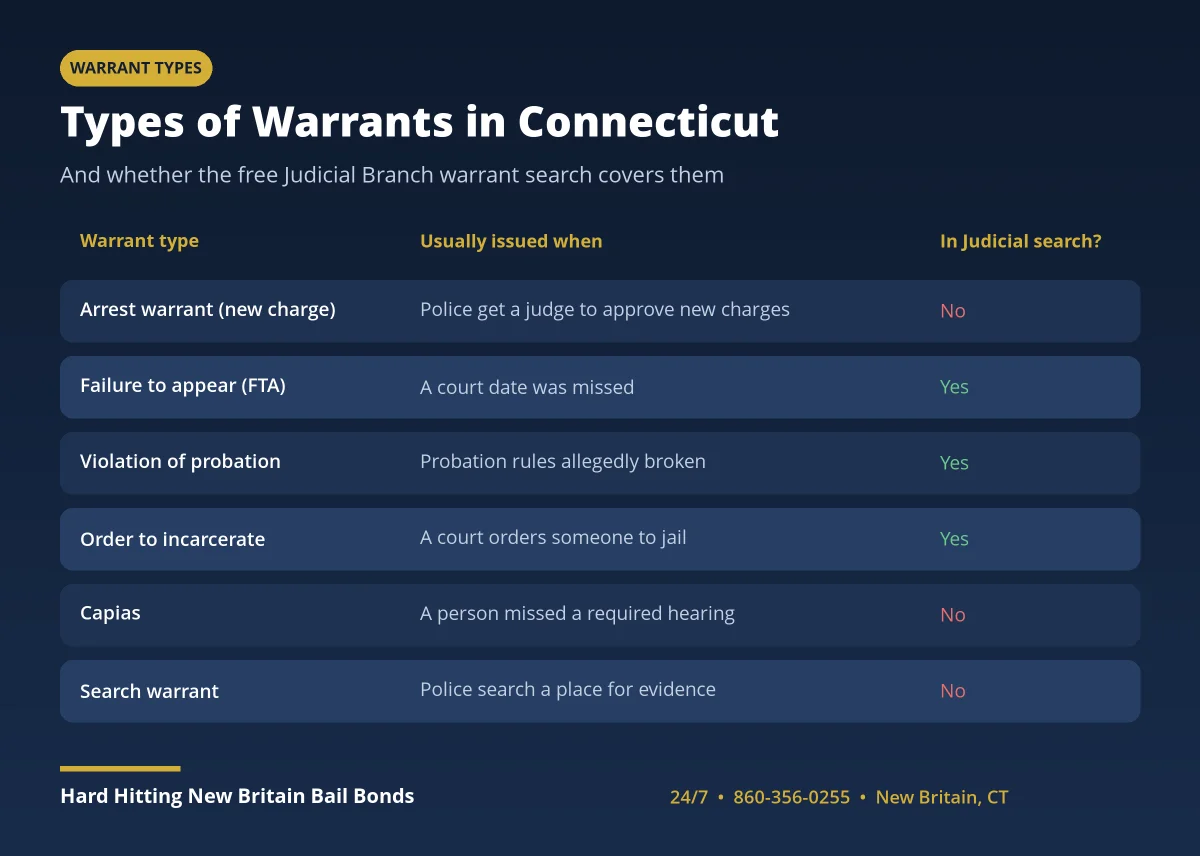
Not every warrant works the same way, and not every warrant shows up in the same search. Here are the types you are most likely to run into:
Arrest warrant for new charges
Police investigate a crime, write an affidavit, and ask a judge to sign an arrest warrant. These warrants often include a bond amount set by the judge. They are generally not listed in the Judicial Branch’s public warrant search until they reach the court system.
Failure to appear (FTA) warrant
If you miss a scheduled court date, the judge can order your rearrest. In Connecticut, failure to appear is also a separate crime, so a missed court date can add a new charge on top of the original case. Learn more about failure to appear bonds in CT.
Violation of probation (VOP) warrant
If a probation officer believes you broke the conditions of your probation, they can seek a warrant for violation of probation. See our page on probation violation bonds in CT.
Order to incarcerate
A court order directing that a person be taken into custody, for example to serve a sentence or because of unpaid court obligations.
Capias
A capias is a type of court order to bring someone before the court, often used when a person fails to appear at a required hearing.
Search warrant
A search warrant lets police search a specific place, such as a home or car, for evidence. It is not a warrant for your arrest, and you cannot look it up the way you can an arrest warrant.
How to Check for Warrants CT: 5 Free Ways
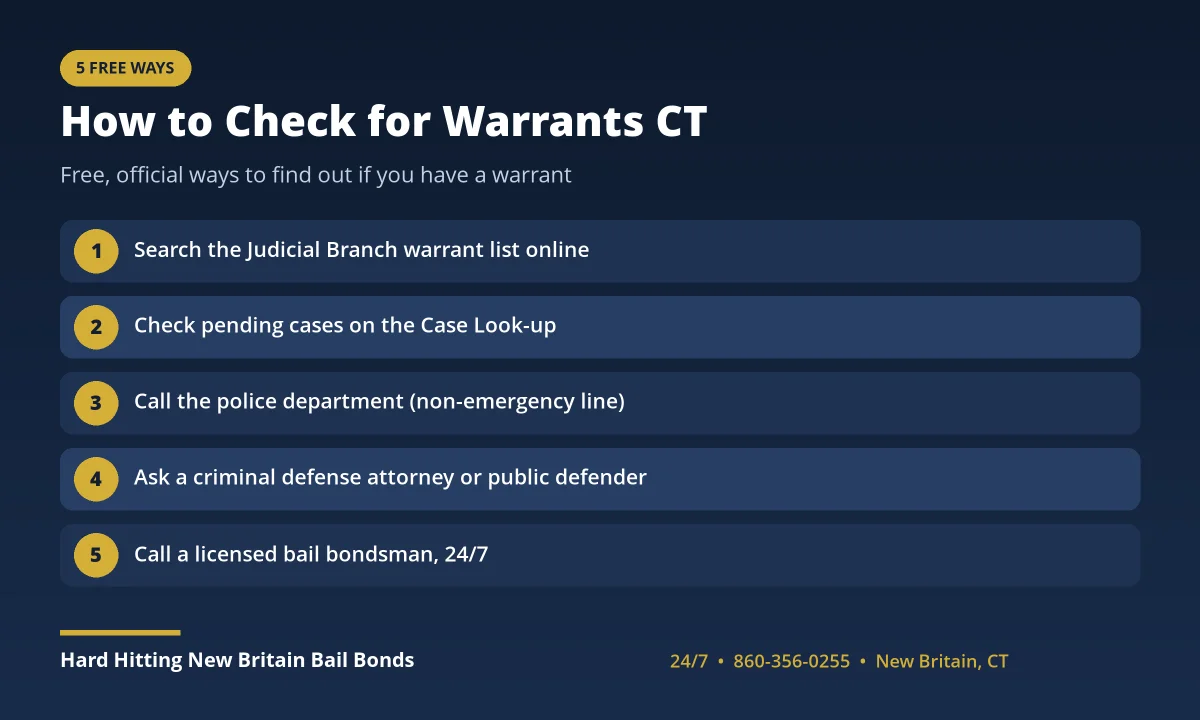
There is no single database that shows every warrant in the state, so the best way to check for warrants CT residents can use is to combine the official tools below.
1. Search the Connecticut Judicial Branch warrant list
The Connecticut Judicial Branch runs a free public search for arrest warrants for violation of probation, failure to appear, and orders to incarcerate. You can search by name, town, or court location, and no account is needed. This is the fastest way to check for warrants CT courts have issued for these three reasons.
Important: this search only covers those three warrant types. A “no results” answer does not mean you have no warrant at all.
2. Check your pending cases on the Case Look-up
The Judicial Branch’s Criminal / Motor Vehicle Case Look-up lets you search pending cases, convictions, and the daily court docket by name or docket number. If you have an open case and missed a date, check the case details and your next court date right away.
3. Call the police department
You can call the non-emergency line of the police department in the town where you think the warrant came from. For New Britain, see our New Britain Police Department bail guide. Keep in mind that if you go to the station in person and there is an active warrant, you can be taken into custody on the spot, so plan ahead before you go.
4. Ask a criminal defense attorney or the public defender
An attorney can check for warrants discreetly, tell you what the warrant is for, and often arrange a time for you to turn yourself in. If you cannot afford a lawyer, ask about the public defender’s office at the courthouse.
5. Call a licensed bail bondsman
A bail bondsman deals with warrants every day. At Hard Hitting New Britain Bail Bonds, we can help you check for warrants CT courts have posted, explain what the results mean, find out the bond amount when it is listed, and have the bail paperwork ready before you surrender. Call us 24/7 at 860-356-0255.
What an Online Warrant Search Will Not Show You
When you check for warrants CT websites can only show what has been entered in their systems. An online search may miss:
- New-charge arrest warrants that police are holding and have not served yet
- Warrants in sensitive investigations that are not made public
- Out-of-state warrants from New York, Massachusetts, or anywhere else
- Very recent warrants that have not been entered yet
- Federal warrants, which are handled by federal courts and agencies
If you have a strong reason to believe a warrant exists, for example, police left a card at your home or a friend was told they are looking for you, talk to an attorney or a bondsman even if the online search comes back empty.
Watch Out for Warrant Scams
Scammers often call people claiming there is a warrant for their arrest and demanding immediate payment by gift card, wire transfer, or cryptocurrency to “clear” it. Courts and police do not cancel warrants over the phone in exchange for payment. If you get a call like this:
- Do not pay and do not share personal information.
- Hang up and look up the court or police department’s official phone number yourself.
- To check for warrants CT residents can trust, use the official Judicial Branch search instead of paid “people search” websites.
What to Do If You Find a Warrant in CT
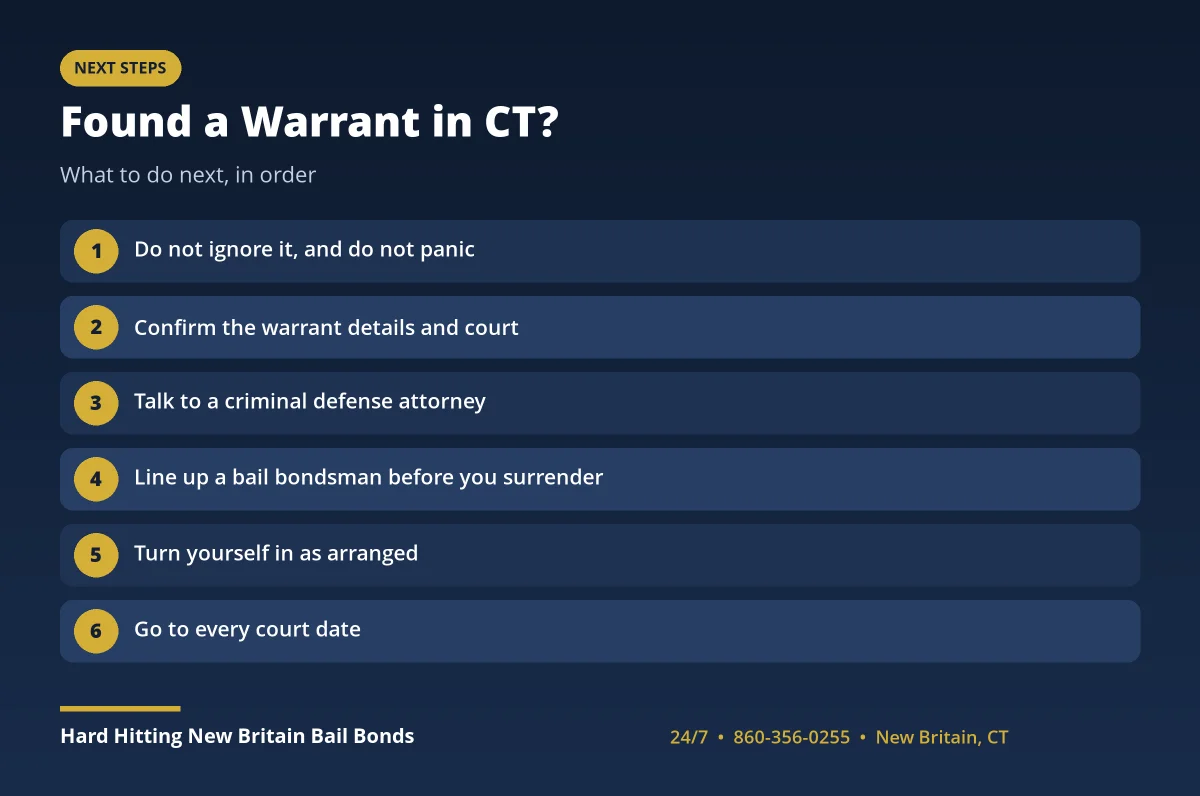
Finding a warrant is stressful, but having a plan makes the process faster and calmer. Here is what we recommend:
- Do not ignore it. A warrant does not go away on its own, and being picked up unexpectedly at work or during a traffic stop is much harder on you and your family.
- Confirm the details. Note the type of warrant, the court, the town, and any bond amount listed.
- Talk to a criminal defense attorney. They can advise you on the safest way to surrender and may be able to ask the court to address the warrant.
- Line up a bail bondsman before you surrender. If you call us first, we can have the bail paperwork ready so you spend as little time in custody as possible.
- Turn yourself in as arranged. Bring photo ID and leave valuables at home.
- Go to every court date. Missing another date can lead to a new failure to appear charge and a higher bond.
Why Turning Yourself In Is Usually the Better Choice
Many people put off dealing with a warrant because they are afraid of going to jail. In practice, waiting usually makes things worse:
- You choose the time and place, instead of being arrested at home, at work, or in front of your family.
- You can arrange bail ahead of time, so release can happen faster.
- Courts often look more favorably on someone who comes forward voluntarily.
- You avoid the risk of new charges, such as another failure to appear.
Before you surrender, read how bail works in New Britain, CT so you know what to expect.
What Happens When You Turn Yourself In
Knowing what to expect makes surrendering on a warrant much less stressful. While every police department and court has its own routine, the process usually looks like this:
- Check-in. You go to the police department or court named on the warrant, at the time your attorney or bondsman arranged, and tell the officer or marshal you are there to turn yourself in.
- Booking. You are fingerprinted and photographed, and your personal property is held until release.
- Bond review. The bond listed on the warrant is confirmed, or a bail commissioner, police officer, or judge sets or reviews the release conditions.
- Posting bail. If you arranged a bail bond ahead of time, your bondsman posts it as soon as it is allowed.
- Release and court date. You are released with paperwork showing your next court date. Put it in your phone right away.
How long this takes depends on the facility and how busy it is. Planning ahead with a bondsman is the best way to keep the time in custody short. You can read more about local facilities on our New Britain jail guide.
Checklist Before You Turn Yourself In
Once you check for warrants CT courts have issued and confirm one exists, gather these items before you go:
- Your government photo ID
- The court name, docket number, or warrant details you found when you checked
- Your attorney’s phone number written on paper, not just saved in your phone
- Your bondsman’s phone number and a confirmed plan for posting bail
- Any medication information you may need while in custody
- Arrangements for work, children, or pets in case the process takes longer than expected
- Leave valuables, large amounts of cash, and anything prohibited at home
Can a Warrant Be Cleared Without Going to Jail?
Sometimes. Depending on the type of warrant and the court, a defense attorney may be able to ask the judge to vacate the warrant or schedule a court date for you to appear, especially for some failure to appear warrants on lower-level charges. In other cases, especially new-charge arrest warrants, you will need to be booked and released on bond. Only an attorney can tell you which option fits your situation, which is another reason to call one as soon as you check for warrants CT courts have issued and find something.
Either way, having a bail bondsman ready means that if you do need to be booked, you will not have to wait while your family scrambles to find bail money.
Do Connecticut Warrants Follow You to Other States?
They can. Many warrants are entered into law enforcement databases that police in other states can see during a traffic stop or background check. Depending on the charge, you could be held until Connecticut decides whether to bring you back. If you are planning to travel or move, it is wise to check for warrants CT courts may have issued and clear them first.
How a Bail Bondsman Helps When You Have a Warrant
A good bondsman does much more than post bail. When you have a warrant, we can:
- Help you check for warrants CT courts have posted and understand the results
- Find the bond amount when it is listed on the warrant
- Prepare the bail paperwork and payment plan before you turn yourself in
- Post the bond at the police department or New Britain courthouse as soon as possible
- Remind you of every court date so the problem does not happen again
Not sure who to call? Read our guide on how to find a trusted bondsman near you.
Checking for Warrants for a Family Member
The Judicial Branch warrant search is public, so you can also use it to check for warrants CT courts have issued for a loved one by name and town. This is common when a family member has missed a court date or has stopped answering the phone. If you find a warrant, encourage them to talk to an attorney and call us so we can help plan a safe surrender and release.
Frequently Asked Questions About Warrants in Connecticut
Can I check for warrants in CT online for free?
Yes. To check for warrants CT courts have issued, the Connecticut Judicial Branch offers a free online search for violation of probation, failure to appear, and order to incarcerate warrants, and a free Case Look-up for pending criminal and motor vehicle cases. No account is needed.
Does the Judicial Branch search show every warrant?
No. It only shows violation of probation, failure to appear, and order to incarcerate warrants. New-charge arrest warrants held by police, out-of-state warrants, and some recent warrants may not appear.
How long does a warrant last in Connecticut?
In most cases, a warrant stays active until it is served, the person turns themselves in, or a judge vacates it. It does not simply expire with time.
Will the police call me if I have a warrant?
Sometimes police or an attorney will contact you, but be careful: callers who demand payment to clear a warrant are almost always scammers. Verify by looking up the official phone number yourself.
Can a bail bondsman check if I have a warrant?
A bondsman can help you search the official records, explain the results, and get your bail ready before you turn yourself in. Call Hard Hitting New Britain Bail Bonds 24/7 at 860-356-0255.
Can I get bail if I am arrested on a warrant?
Often, yes. Many warrants list a bond amount set by the judge. Once you are processed, a bondsman can post that bond so you can be released while the case continues.
Is it a crime to miss court in Connecticut?
Yes. Failure to appear is a separate crime in Connecticut, and it can be charged as a felony if the original case was a felony. That is why it is important to check for warrants CT courts may have issued after a missed date and resolve them quickly.
Where do I turn myself in on a warrant in New Britain?
Usually at the police department that holds the warrant or at the court named on it. An attorney or your bondsman can confirm the right place and time before you go.
Does a warrant show up on a background check?
It can. Active warrants may appear on some criminal background checks and are visible to police during routine stops, which is why it is better to resolve them quickly.
Found a Warrant? Call Hard Hitting New Britain Bail Bonds 24/7
If you need to check for warrants CT courts may have issued, or you already know there is one, you do not have to handle it alone. Hard Hitting New Britain Bail Bonds can help you understand your options and have your bail ready before you walk in, any time of day or night.
Call or text 860-356-0255 or visit our office at 200 Main St, New Britain, CT 06051. Have more questions? See our bail bonds FAQ.
This article is for general information only and is not legal advice. Talk to a Connecticut criminal defense attorney about your specific situation.