
If a family member was just arrested, you have probably heard people argue about cashless bail on the news and wondered whether it applies to your situation. The short answer for Connecticut families: not yet. Cashless bail is a pretrial system where people are released without paying money, and it already exists in states like Illinois and New Jersey. Connecticut still uses money bonds, but the rules have changed a lot since 2017, and lawmakers are debating further changes right now.
This guide explains what cashless bail is, how it works, where it is used, the real pros and cons, and what all of it means if you need to get someone out of jail in New Britain today.
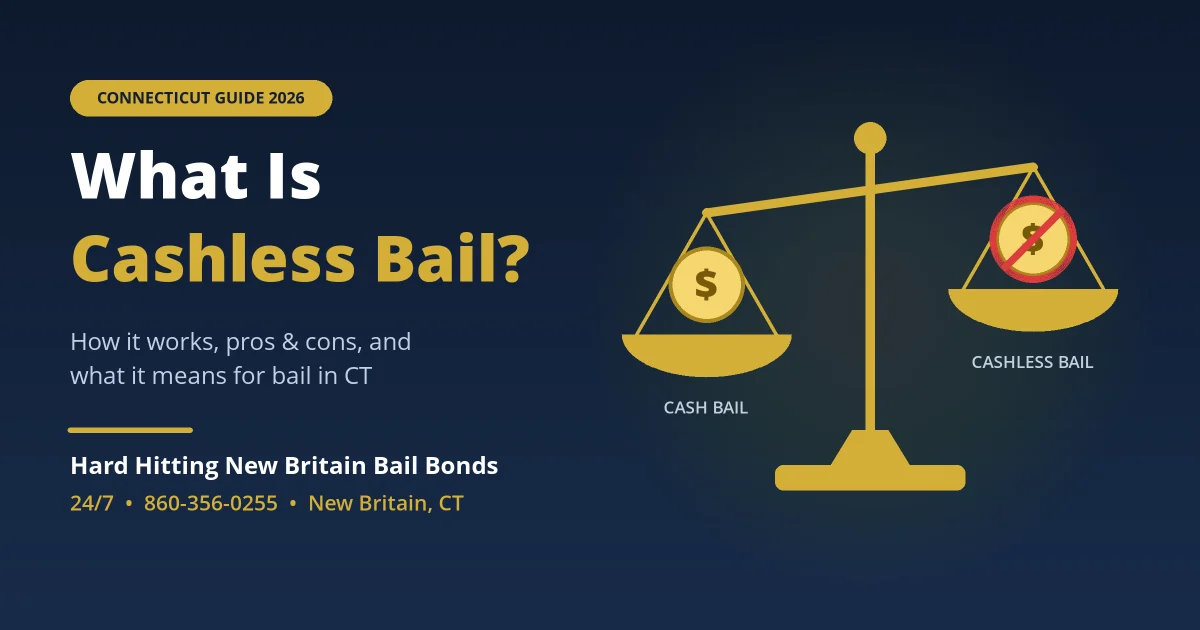
Table of Contents
Cashless Bail: Key Takeaways
- Cashless bail lets judges release people before trial based on risk, not money.
- Illinois is the only state that has fully ended cash bail; New Jersey and Washington, D.C. come close.
- Connecticut does not have cashless bail. Money bonds are still used, though limited for most misdemeanors since 2017.
- Since January 1, 2024, Connecticut lets people pay 7% of a bond of $50,000 or less directly to the court.
- For larger bonds, or when cash is not available, a licensed bail bondsman is still the most common way to get a loved one home.
What Is Cashless Bail?
Cashless bail is a pretrial release system in which a judge decides whether an arrested person can go home before trial based on risk, not money. Instead of setting a dollar amount, the court either releases the person (often with conditions such as check-ins or electronic monitoring) or, in serious cases, orders them held without bail.
Under traditional cash bail, the question is “Can you pay?” Under cashless bail, the question becomes “Are you likely to come back to court, and are you a danger to anyone?” To understand the traditional system first, see our guide on how bail works in New Britain, CT.
How Cashless Bail Works, Step by Step
Cashless bail systems differ from state to state, but most follow the same basic path:
- Arrest and booking. The person is fingerprinted, photographed, and checked for warrants, just like in any other system.
- Risk assessment. Pretrial staff review the charge, criminal record, and past court attendance. Many states use a scoring tool, such as New Jersey’s Public Safety Assessment.
- First court appearance. A judge reviews the assessment and hears from the prosecutor and defense lawyer.
- Release decision. The judge picks one of three outcomes (explained below).
- Pretrial supervision. If released, the person must follow every condition and attend every court date until the case ends.
- Consequences for violations. Missing court or breaking a condition can lead to a warrant, new charges, or being jailed until trial.
Release on recognizance
For many low-level charges, the person simply signs a promise to return to court and goes home. No money changes hands.
Release with conditions
When a judge sees more risk, release can come with rules such as regular check-ins with a pretrial officer, a curfew, travel limits, no-contact orders, drug testing, or an ankle monitor.
Pretrial detention
Cashless bail does not mean everyone goes free. In most cashless systems, prosecutors can ask a judge to hold a person who is considered dangerous or a serious flight risk, and that person stays in jail with no option to buy their way out.
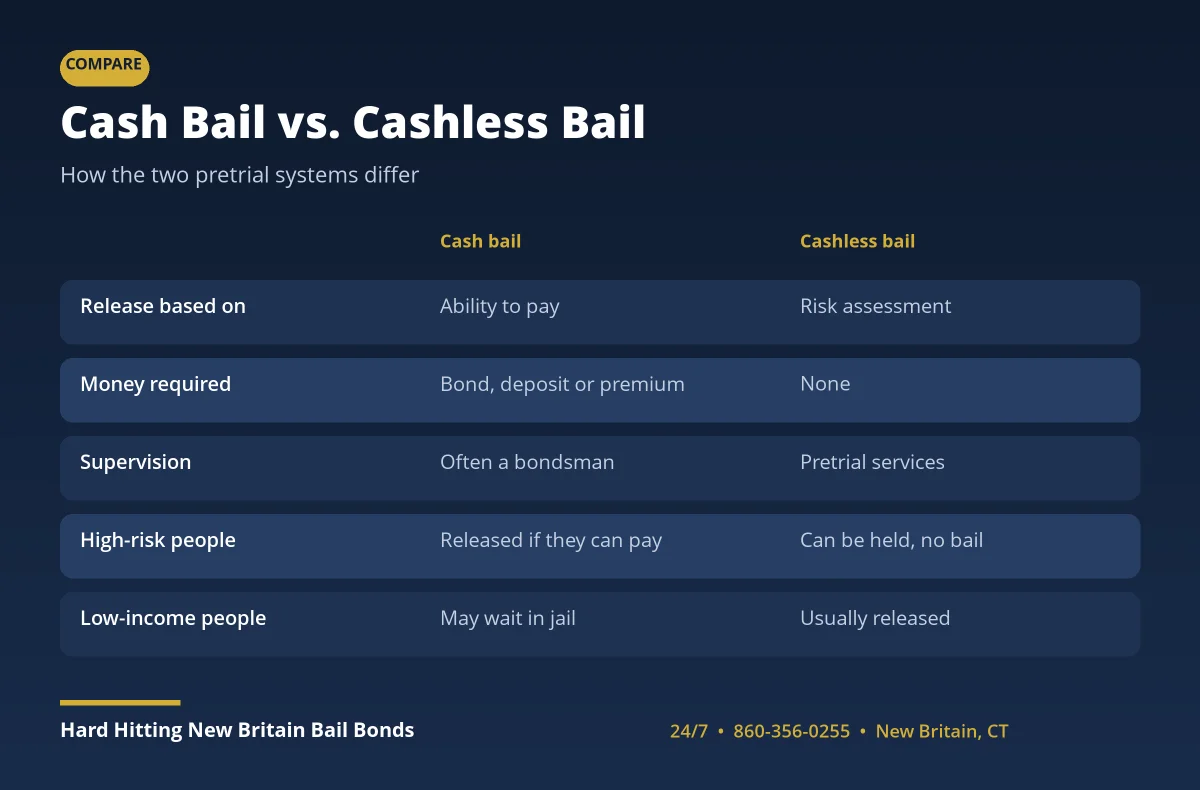
Cash Bail vs. Cashless Bail: Key Differences
| Cash bail | Cashless bail | |
|---|---|---|
| What decides release | Ability to pay the bond amount | Judge’s assessment of flight risk and danger |
| Money required | Full bond, a court deposit, or a bail bondsman’s fee | None |
| Who supervises the person | Often the bail bondsman, who has money at stake | Pretrial services staff, through check-ins or monitoring |
| High-risk defendants | Can be released if they can afford the bond | Can be held with no bail at all |
| Low-income defendants | May sit in jail for weeks or months | Usually released if low risk |
| Incentive to return to court | Losing the money paid or pledged | Warrant, new charges, or detention |
Where Cashless Bail Is Used in the United States
Cashless bail is not one national law. Each state, and Washington, D.C., sets its own rules. Key examples:
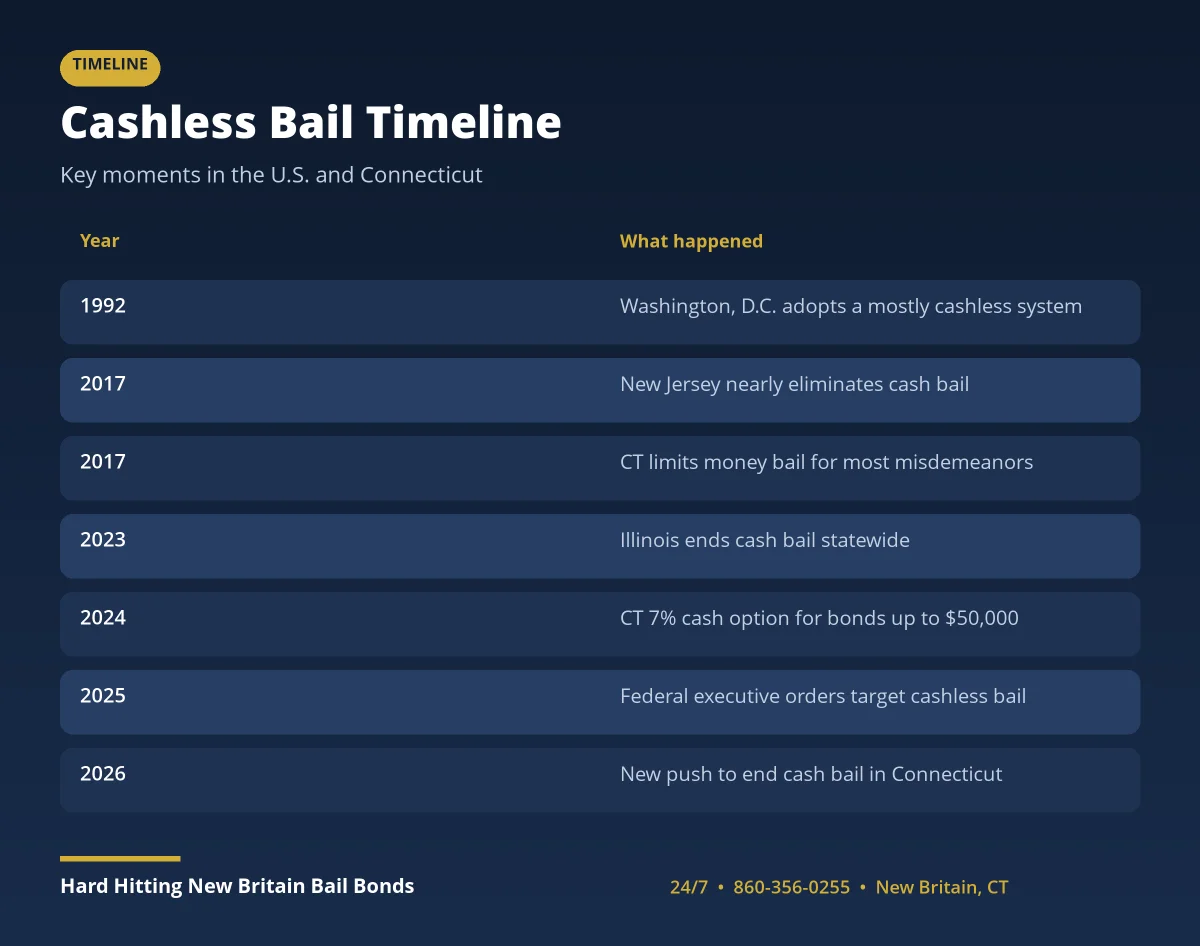
- Illinois became the first state to fully abolish cash bail. Its Pretrial Fairness Act, part of the larger SAFE-T Act, took effect in all 102 counties on September 18, 2023, after the Illinois Supreme Court upheld it in a 5–2 ruling.
- New Jersey nearly eliminated cash bail when its Criminal Justice Reform Act took effect in January 2017, replacing money with a risk-based system and a statewide pretrial monitoring program.
- Washington, D.C. has used a mostly cashless system since 1992.
- New York removed cash bail for most misdemeanors and many nonviolent felonies starting in 2020, then amended those rules several times after public debate.
Other states, including Connecticut, have taken smaller steps, limiting money bail for minor charges or offering cheaper ways to post a bond without fully dropping cash bail.
Is There Cashless Bail in Connecticut?
No. Connecticut does not have cashless bail. Money bonds are still a normal part of the system. Here is where the state stands in 2026.
Connecticut’s constitution guarantees a right to bail
The Connecticut Constitution gives accused people a right to be released on bail, except in capital cases. That matters because it means the state cannot simply switch to a New Jersey-style system where judges hold people with no bail; experts note the constitution would need to be amended first.
The 2017 pretrial reform law
In 2017, Connecticut passed a pretrial justice reform law (Public Act 17-145) that took effect on July 1, 2017. It:
- barred courts from setting money bail for most misdemeanor charges, except in family violence cases or when a person is a flight risk or likely to obstruct justice, and
- ended cash-only bonds for those cases.
The results were mixed. State data showed a 94% drop in people held on cash-only bonds between July 2017 and September 2019, but the total number of people held before trial stayed roughly the same.
The 7% cash option (since January 1, 2024)
The change most likely to affect your family is Connecticut’s percentage cash option. Since January 1, 2024, people can pay 7% of a bond of $50,000 or less directly to the court, instead of using a bail bondsman. Before that, the option was 10% and limited to bonds of $20,000 or less.
Key points about the court cash option:
- It only applies to bonds of $50,000 or less.
- The money must usually be paid in full, up front, in cash.
- If the person goes to every court date, the deposit is generally returned at the end of the case, minus fees.
- If the person skips court, they can be held responsible for the full bond amount. Learn more about failure to appear bonds in CT.
Types of release in Connecticut
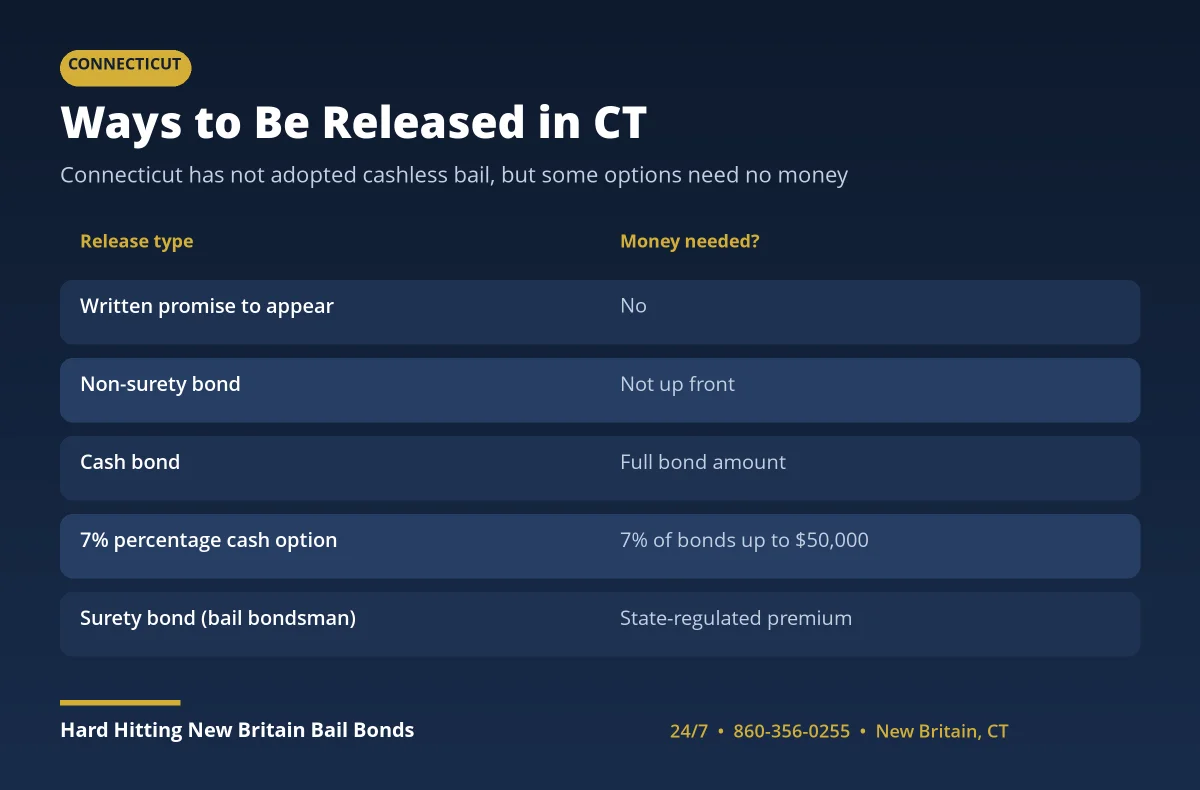
To understand where Connecticut stands, it helps to know the main ways a person can be released before trial in the state:
| Release type | What it means | Money needed? |
|---|---|---|
| Written promise to appear | The person signs a promise to come back to court. | No |
| Non-surety bond | The person promises to pay a set amount only if they miss court. | Not up front |
| Cash bond | The full bond amount is paid to the court and returned after the case if every date is kept. | Yes, the full amount |
| Percentage cash option | 7% of a bond of $50,000 or less is paid directly to the court. | Yes, 7% up front |
| Surety bond | A licensed bail bondsman posts the bond for a state-regulated, non-refundable premium. | Yes, the premium |
The first two options already work without money changing hands, which is why some people describe parts of Connecticut’s system as partly cash-free. But whenever a judge or police department sets a cash or surety bond, someone still has to pay before the person goes home.
Connecticut’s 2026 cashless bail debate
In August 2026, advocates launched a new push to end cash bail in Connecticut, pointing out that roughly one in three people in Connecticut prisons have not been convicted and are waiting for trial. So far, the idea has received a lukewarm response from both Governor Ned Lamont and his Republican challenger. For now, there is no law ending cash bail in Connecticut, and any full change would likely require a constitutional amendment.
The Pros and Cons of Cashless Bail
Cashless bail is one of the most debated topics in criminal justice. Here is the strongest case made on each side.
Arguments for cashless bail
- Fairness. Supporters argue that two people facing the same charge should not have different outcomes just because one can afford bail.
- Jobs and families. Even a few days in jail can cost someone their job, apartment, or custody arrangements, before they have been convicted of anything.
- Lower jail costs. Holding fewer low-risk people saves taxpayers money.
- Research from New Jersey. New Jersey’s pretrial jail population fell about 44% between the end of 2015 and the end of 2019, and a 2024 study in JAMA Network Open found the reform did not increase gun violence. Court appearance rates stayed just below 90%.
Arguments against cashless bail
- Public safety concerns. Police groups, prosecutors, and many lawmakers argue that releasing more people before trial leads to repeat offenses, and they point to high-profile cases of people re-arrested while on release.
- Less incentive to return to court. With no money at stake, critics say some defendants are more likely to skip court dates.
- Strain on courts and pretrial services. Detention hearings, check-ins, and electronic monitoring take staff and money that many courts lack.
- Less accountability. Under cash bail, a bail bondsman has a financial reason to make sure the client shows up, and will track them down if they do not. Pretrial agencies often cannot offer that same one-on-one follow-up.
The evidence is still debated, and results vary widely depending on how each state designs its system.
Common Myths About Cashless Bail
Because cashless bail is so often in the news, a lot of misinformation gets passed around. Here are the most common myths and what is actually true.
Myth 1: Cashless bail means everyone is released
Fact: In most cashless bail systems, judges can still hold people who are considered dangerous or likely to flee. In some cases, they can be held with no option to pay their way out at all.
Myth 2: People released without bail have no rules to follow
Fact: Release often comes with conditions such as check-ins, curfews, travel limits, no-contact orders, or electronic monitoring. Breaking them can lead to a warrant and jail.
Myth 3: Connecticut already has cashless bail
Fact: Connecticut has limited money bail for most misdemeanors and created a percentage cash option, but it has not eliminated cash bail. The state constitution’s right to bail would likely need to be amended first.
Myth 4: Bail bondsmen no longer exist where cashless bail is debated
Fact: In Connecticut, licensed bail bondsmen still post most bonds, especially for amounts over $50,000 or when a family does not have the full cash deposit available.
Myth 5: The research on cashless bail is settled
Fact: Studies from places like New Jersey show encouraging results on jail populations and gun violence, but supporters and critics still disagree about public safety, and results depend heavily on how each system is designed.
The Federal Push Against Cashless Bail
On August 25, 2025, President Donald Trump signed two executive orders targeting cashless bail. One focused on Washington, D.C. The other directed the U.S. Attorney General to list states and cities with cashless bail policies and told federal agencies to identify grants and contracts to those places that could be suspended or ended.
Bail law is still set mostly by the states, so the orders do not by themselves change any state’s rules. They do add pressure on places that have adopted cashless bail and make it less likely that more states will follow soon.
What This Means If You Need Bail in New Britain Today
While the national debate continues, the rules in Connecticut today are clear: if a judge or police department sets a money bond, someone has to post it before your loved one can go home. Your options usually are:
- Pay the full bond in cash to the court and get it back when the case ends (if every court date is kept).
- Use the 7% court option if the bond is $50,000 or less and you have the cash on hand.
- Work with a licensed bail bondsman (see how to find a trusted bondsman near you) who posts a surety bond for a fee, often with payment plans.
A bail bondsman is often the fastest route when:
- the bond is over $50,000, so the 7% court option is not available,
- you do not have the full deposit in cash right now,
- the arrest happens late at night, on a weekend, or on a holiday, or
- you want someone who knows the New Britain courthouse and Hartford County courts to guide you through the paperwork and court dates.
See all of our bail bond services, or read the answers to more questions on our bail bonds FAQ page.
Frequently Asked Questions About Cashless Bail
What does cashless bail mean in simple terms?
Cashless bail means a person can be released from jail before trial without paying any money. A judge decides based on risk of flight and danger to others, and may add conditions such as check-ins or an ankle monitor.
Does Connecticut have cashless bail?
No. Connecticut still uses money bonds. Since 2017, money bail is limited for most misdemeanors, and since 2024 people can pay 7% of a bond up to $50,000 to the court, but cash bail has not been eliminated.
Which state was the first to end cash bail completely?
Illinois. Its Pretrial Fairness Act, part of the SAFE-T Act, ended cash bail statewide on September 18, 2023.
Is cashless bail the same as being released for free with no rules?
No. People released under cashless bail usually must follow conditions and attend every court date. Breaking the rules can lead to a warrant and jail time, and high-risk defendants can be held with no bail at all.
What is the 7% bail option in Connecticut?
It lets a person pay 7% of a bond of $50,000 or less directly to the court instead of using a bail bondsman. The deposit is generally refunded, minus fees, if the person attends all court dates.
Can I still use a bail bondsman in Connecticut?
Yes. Licensed bail bondsmen operate across Connecticut and can post bonds of any size, often with payment plans, which helps when the bond is above $50,000 or the family cannot pay the full deposit at once.
Did President Trump ban cashless bail?
No president can ban it directly, because bail rules are set mainly by states. In August 2025, President Trump signed executive orders aimed at ending cashless bail in Washington, D.C., and pressuring other jurisdictions by threatening federal funding.
Does cashless bail increase crime?
The evidence is mixed and still debated. New Jersey’s reform cut its pretrial jail population without an increase in gun violence according to a 2024 study, while critics point to individual cases of people re-arrested while on release.
Will Connecticut get cashless bail soon?
Not likely in the near term. Advocates renewed their push in 2026, but leading candidates for governor gave the idea a lukewarm response, and a full change would probably require amending the state constitution.
Need Bail in New Britain? Call Hard Hitting Bail Bonds 24/7
Cashless bail may be in the headlines, but in Connecticut, getting a loved one home still usually means posting a bond. Hard Hitting New Britain Bail Bonds is available 24 hours a day, 7 days a week to explain your options, compare the court’s 7% option with a bail bond, and get the release process started fast.
Call 860-356-0255 or visit us at 200 Main St, New Britain, CT 06051. Email: info@hardhittingnewbritainbailbonds.com
This article is for general information only and is not legal advice. Bail laws change; speak with a Connecticut criminal defense attorney about your specific case.